Friday, September 26, 2008

Chapter 11 "Caduceus"


The caduceus or wand of Hermes is typically depicted as a short herald's staff entwined by two serpents in the form of a double helix, and sometimes surmounted by wings. In later Antiquity the caduceus may have provided the basis for the astrological symbol representing the planet Mercury and in Roman iconography was often depicted being carried in the left hand of the Greek god Hermes, the messenger of the gods, guide of the dead and protector of merchants, gamblers, liars and thieves.

The caduceus is sometimes used as a symbol for medicine, especially in North America, through confusion with the traditional medical symbol, the rod of Asclepius, which has only a single snake and no wings. Given the historically attested use of this emblem, its adoption as a symbol of medicine is a great irony.

As early as 1910, Dr. William Hayes Ward discovered that symbols similar to the classical caduceus appeared not infrequently on Mesopotamian cylinder seals. He suggested the symbol originated some time between 3000 and 4000 BCE, and that it might have been the source of the Greek caduceus. A.L. Frothingham incorporated Dr. Ward's research into his own work, published in 1916, in which he suggested that the prototype of Hermes was an "Oriental deity of Babylonian extraction" represented in his earliest form as a snake god. From this perspective, the caduceus was originally representative of Hermes himself, in his early form as the god Ningishzida, "messenger" of the "Earth Mother". However, more recent classical scholarship makes no mention of Babylonian origin for Hermes or the caduceus.


Among the Greeks the caduceus is thought to have originally been a herald's staff. The Latin word caduceus (possibly caduceum) is an adaptation of the Greek kerukeion, meaning "herald's wand (or staff)", deriving from kerux, meaning "herald" or "public messenger", which in turn is related to kerusso, meaning "to announce" (often in the capacity of herald). The staff of the herald is thought to have developed from a shepherd's crook, in the form of a forked olive branch adorned with first two fillets of wool, then with white ribbons and finally with two snakes intertwined. However no explanation as to how such an object would be practically used as a functional crook by shepherds is offered.

One Greek myth of origin of the caduceus is part of the story of Tiresias,who found two snakes copulating and killed the female with his staff. Tiresias was immediately turned into a woman, and so remained until he was able to repeat the act with the male snake seven years later. This staff later came in to the possession of the god Hermes, along with its transformative powers. Another myth relates how Hermes played a lyre fashioned from a tortoise shell for Apollo, and in return was appointed ambassador of the gods with the caduceus as a symbol of his office. Another tale suggests that Hermes (or more properly the Roman Mercury) saw two serpents entwined in mortal combat. Separating them with his wand he brought about peace between them, and as a result the wand with two serpents came to be seen as a sign of peace.

In Rome, Livy refers to the caduceator who negotiated peace arrangements under the diplomatic protection of the caduceus he carried.


Ive added this information, in case you want to find out what and where is the Symbol from.

Thursday, September 25, 2008

Chapter 10 "The Hexagram"


Throughout the research, readers might have notice the usage of the in the left side. What is this symbol is about exactly, and why is it seen for almost anywhere, everywhere. Games, Spell castings, Alchemy itself use the image. Below is a brief history of this image that may give us a view of what it really is.


Origins and shape

The hexagram is a mandala symbol called satkona yantra or sadkona yantra found on ancient South Indian Hindu temples built thousands of years ago. It symbolizes the nara-narayana, or perfect meditative state of balance achieved between Man and God, and if maintained, results in "moksha," or "nirvana" (release from the bounds of the earthly world and its material trappings).

Another theory about the origin of the shape is that it is simply 2 of the 3 letters in the name David: in its Hebrew spelling, David is transliterated as 'D-W-D'. In Biblical Hebrew, the letter 'D' (Dalet) was written in a form much like a triangle, similar to the Greek letter "Delta" (Δ). The symbol may have been a simple family crest formed by flipping and juxtaposing the two most prominent letters in the name. The letter "W" in this case could reference the compositing operation of the two Deltas.

Some researchers have theorized that the hexagram represents the astrological chart at the time of David's birth or anointment as king. The hexagram is also known as the "King's Star" in astrological circles.

In antique papyri, pentagrams, together with stars and other signs, are frequently found on amulets bearing the Jewish names of God, and used to guard against fever and other diseases. Curiously the hexagram is not found among these signs. In the great magic papyrus at Paris and London there are twenty-two signs side by side, and a circle with twelve signs, but neither a pentagram nor a hexagram.

Therefore, the syncretism of Hellenistic, Jewish, and Coptic influences probably did not originate the symbol.

It is also possible that as a simple geometric shape, like for example the triangle, circle, or square, the hexagram has been created by various different peoples with no connection to one another.


Usage by Christians

The hexagram may be found in some Churches and stained-glass windows. Example of this is one embedded in the ceiling of the Washington National Cathedral. Because the similar-looking sign called the encircled pentagram used in occultism, it was not used in church architecture until Christian architects, both Protestant and Catholic, began to accept the notion that the Star of David is an old Jewish sign.In Christianity it is often called the star of creation.

The Bible makes no direct mention of the Star of David, however, the Catechism of the Catholic Church of the year 528 refers to the star which led the Magi to Christ as "the Star of David". In the context, the phrase most likely meant "the star of the king of Israel" rather than the double triangle-shaped symbol used today.


Usage by Jews

Magen David is a generally recognized symbol of Judaism and Jewish identity and is also known colloquially as the Jewish Star or "Star of David". Its usage as a sign of Jewish identity began in the Middle Ages, though its religious usage began earlier, with the current earliest archeological evidence being a stone bearing the shield from the arch of a 3-4th century synagogue in the Galilee. A more enduring symbol of Judaism, the menorah, has been in use since BCE.


Wednesday, September 24, 2008

Chapter 9 "Cabala the Spiritual Alchemy"


Kabbalah
is a discipline and school of thought discussing the mystical aspect of Judaism. It is a set of esoteric teachings meant to define the inner meaning of both the Tanakh (Hebrew Bible) and traditional Rabbinic literature, as well as to explain the significance of Jewish religious observances.


The origins of the actual term Kabbalah are unknown and disputed to belong either to Solomon ibn Gabirol (1021 - 1058) or else to the 13th century CE Spanish Kabbalist Bahya ben Asher. While other terms have been used in many religious documents from the 2nd century CE up to the present day, the term Kabbalah has become the main descriptive of Jewish esoteric knowledge and practices. The Kabbalistic literature, which served as the basis for most of the development of Kabbalistic thought, divides between early works such as Heichalot and Sefer Yetzirah (believed to be dated 1st or 2nd Century CE) and later works dated to the 13th century CE, of which the main book is the Zohar representing the main source for the Contemplative Kabbalah ("Kabbalah Iyunit").

According to Kabbalistic tradition, knowledge was transmitted orally by the Patriarchs, prophets, and sages (Hakhamim in Hebrew), eventually to be "interwoven" into Jewish religious writings and culture. According to this tradition, Kabbalah was, in around the 10th century BCE, an open knowledge practiced by over a million people in ancient Israel,[4] although there is little objective historical evidence to support this thesis.

Foreign conquests drove the Jewish spiritual leadership of the time (the Sanhedrin) to hide the knowledge and make it secret, fearing that it might be misused if it fell into the wrong hands.[5]Diaspora), unsupervised and unguided by the masters, might lead them into wrong practice and forbidden ways. As a result, the Kabbalah became secretive, forbidden and esoteric to Judaism (“Torat Ha’Sod The Sanhedrin leaders were also concerned that the practice of Kabbalah by Jews deported on conquest to other countries (the Hebrew:for two and a half millennia.

It is hard to clarify with any degree of certainty the exact concepts within Kabbalah. There are several different schools of thought with very different outlooks; however, all are accepted as correct. Modern Halakhic authorities have tried to narrow the scope and diversity within Kabbalah, by restricting study to certain texts, notably Zohar and the teachings of the Isaac Luria as passed down through Haim Vital.However even this qualification does little to limit the scope of understanding and expression, as included in those works are commentaries on Abulafian writings, Sepher Yetzirah, Albotonian writings, and Brit Menuhah.It is therefore important to bear in mind when discussing things such as the Sephirot and their interactions that one is dealing with highly abstract concepts that at best can only be understood intuitively.


According to Lurianic cosmology, the Sephirot correspond to various levels of creation (ten sephirot in each of the four worlds, and four worlds within each of the larger four worlds, each containing ten sephirot, which themselves contain ten sephirot, to an infinite number of possibilities[13]), and are emanated from the Creator for the purpose of creating the universe. The Sephirot are considered revelations of the Creator's will (ratzon)[14], and they should not be understood as ten different "gods" but as ten different ways the one God reveals his will through the Emanations. It is not God who changes but the ability to perceive God that changes.

The names of the ten Sephirot are:


Tuesday, September 23, 2008

Chapter 8 "Tree of Life"


In connection to the search of the Philosopher's Stone, I have stumble into some information in some books, reviews, and the internet, one of these had really caught my attention, its the ideas and teachings by "Kabbalah" or "cabala" in english translation. These teachings (i dont know if its a religion) would be discuss on Chapter 9 so please be patient.
This post is suppose to focus on one of the important fields in the particular ideas in cabala, the "Tree of Life". (as seen above)

Go to this link for the Flash version(recomended):

http://www.hermeticgoldendawn.org/Animated.htm

I have read several physics books today, and I remember dealing with the dimensions, the parallel worlds they happen to mention, and some other ideas that says there are world out there but in different dimensions. Separated by our basic counting number (1-etc). They have said that we are in the Third dimension, having Length, Width, and thickness, and the base shape would be the "Triangle" as it has three sides, like having three properties or characteristics. Further explanation of the physics dimensions is that, lower dimensions a cannot comprehend higher dimension, that is why we people cannot determine what 4th dimension is, we of course are capable of understanding the 2 dimensional world coz its lower that where we are. It is believe in that book that the Last dimension (10th) is where God is.
Notice the animated of the Tree of Life, every steps, every circle corresponds with a shape, second is the two axis direction, the 2 dimensional aspect, up and down, right and left...have you notice the connection between Physics and cabala? The next figure, the triangle, three properties, three sides, that could mean 3 dimension and so on. If we analyze these using both physics and cabala, we could say that:

Our true birth begins (1st dimension) , afterward we transfer to the 2 dimensional world, then transfer again (we can see it by means of death like what happen people), then to the third dimensional world. If we would think, souls, or ghost, or anything paranormal, they can walk through walls and go wherever they want, this is a manifestation of a higher dimensional living being. If us, 3 dimensional beings would go to the 2 dimensional world, these people living in the 2 dimensional would see us as a mighty thing, more like God in some point because, we are not hindered by the limitations of there dimension, see example below:

An example of a 2 dimensional world:
Fig 1:


They were like comic characters, they don't have thickness and the only direction they know is up down, right left. There world is like a floating paper in the air where in if the 3 dimensional being enters, only the portion of what had intersect the 3D the 2d can see.
See figure for visual:


If deaths we see in Earth is a mean of transferring to another dimension then Ghost and everything panoramic events which we cannot comprehend are the evidence.

Physics and the lessons of Spiritual alchemy conveys a message that everything is connected, Ancient Civilizations, there achievements, wonders of the world and how they're made, nature secrets, advance science, magistry, and everything! There are a lot of things we need to find out, be with me people.


The secret of the Philosopher's Stone and of prolonging human life is still hidden, but who know reader, this may be a clue that we need to think through, that idea of One, everything is connected and is a manifestation from a single root. I remember the first post's, the book of abraham said about the connection of all, maybe...we need to study all sciences and connect them all.! LOL..have a nice day...I'm gonna read some more to find something out again.

Monday, September 22, 2008

Chapter 7 "Secret Societies"


Have you ever heard about secret socities in recent times? Yes you may have, in movies, in different media types where fantasies are known to men. But there's something I've seen today that had open my mind in some things again.
It's about the Secret Societies practicing mystical arts at
recent times, this post doesn't aim to promote these groups
but I urged the readers better not to go with them.
These societies offers teachings towards cabala, alchemy, occult, voodoo, and magistracy.
Just like in Harry Potter series, the inter schools that teach different arts, its very similar,
there are a lot of books to be posted hereby after some few post, we will reach there as soon as possible.


*here..few were only given, ther
e's still lots of em out there, search for them if
you were really interested.


Freemasonry


Freemasonry is a fraternal organisation that arose from obscure origins in the late 16th to early 17th century. Freemasonry now exists in various forms all over the world, with a membership estimated at around 5 million (including around 480,000 in England, Scotland and Ireland alone, and just under two million in the United States).[1][2] The various forms all share moral and metaphysical ideals, which include, in most cases, a constitutional declaration of belief in a Supreme Being.[3]

The fraternity is administratively organised into Grand Lodges (or sometimes Orients), each of which governs its own jurisdiction, which consists of subordinate (or constituent) Lodges. Grand Lodges recognise each other through a process of landmarks and regularity. There are also appendant bodies, which are organisations related to the main branch of Freemasonry, but with their own independent administration.

Freemasonry uses the metaphors of operative stonemasons' tools and implements, against the allegorical backdrop of the building of King Solomon's Temple, to convey what has been described by both Masons and critics as "a system of morality veiled in allegory and illustrated by symbols


The origins and early development of Freemasonry are a matter of some debate and conjecture. There is some evidence to suggest that there were Masonic Lodges in existence in Scotland as early as the late sixteenth century,[6] and clear references to their existence in England by the mid seventeenth century.[7] A poem known as "The Regius Manuscript" has been dated to approximately 1390 and is the oldest known Masonic text.[8]

The first Grand Lodge, the Grand Lodge of England (GLE), was founded on 24 June 1717, when four existing London Lodges met for a joint dinner. This rapidly expanded into a regulatory body, which most English Lodges joined. However, a few lodges resented some of the modernisations that GLE endorsed, such as the creation of the Third Degree, and formed a rival Grand Lodge on 17 July 1751, which they called the "Antient Grand Lodge of England". The two competing Grand Lodges vied for supremacy—the "Moderns" (GLE) and the "Antients" (or "Ancients")—until they united 25 November 1813 to form the United Grand Lodge of England (UGLE).


Rosicrucian Order
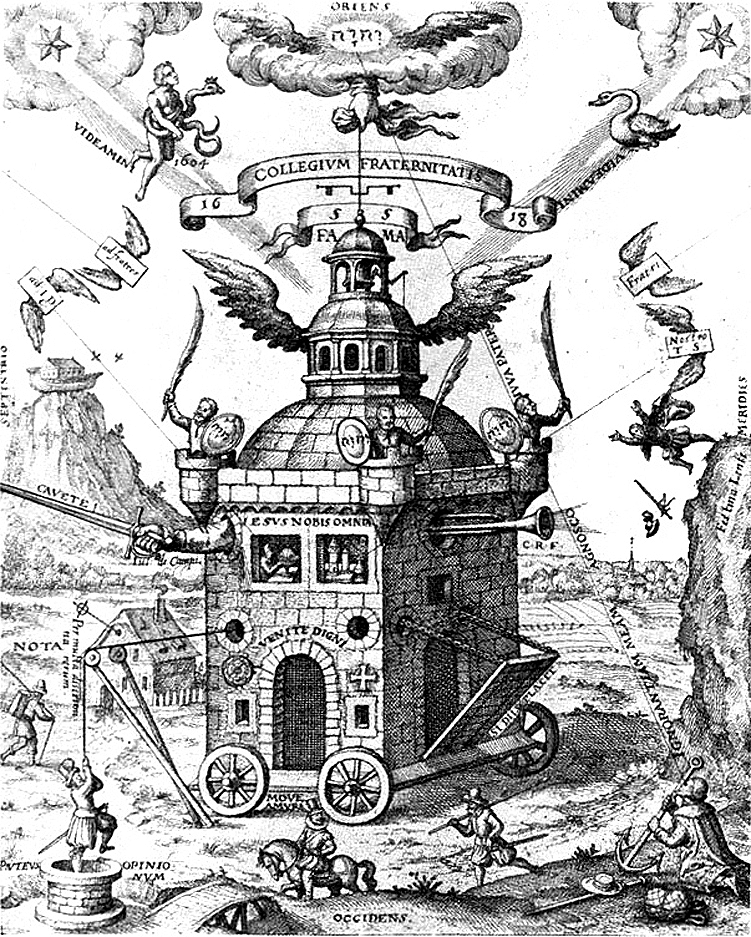


The term Rosicrucian (symbol: the Rose Cross) describes a secret society of mystics, allegedly formed in late mediaeval Germany, holding a doctrine "built on esoteric truths of the ancient past", which, "concealed from the average man, provide insight into nature, the physical universe and the spiritual realm. " [1]

Between 1607 and 1616, two anonymous manifestos were published, first in Germany and later throughout Europe[citation needed]. These were Fama Fraternitatis RC (The Fame of the Brotherhood of RC) and Confessio Fraternitatis (The Confession of the Brotherhood of RC). The influence of these documents, presenting a "most laudable Order" of mystic-philosopher-doctors and promoting a "Universal Reformation of Mankind", gave rise to an enthusiasm called by its historian Dame Frances Yates the "Rosicrucian Enlightenment".[2]

In later centuries many masonic and occult societies have claimed to derive their doctrines, in whole or in part, from the original Rosicrucians. Several modern societies, which date the beginning of the Order to earlier centuries, have been formed for the study of Rosicrucianism and allied subjects. However, many researchers[who?] on the history of Rosicrucianism argue that modern Rosicrucianists are in no sense directly linked to any real society of the early 17th century.


Order of the Golden Dawn

The Hermetic Order of the Golden Dawn (or, more commonly, the Golden Dawn) was a magical order of the late 19th and early 20th centuries, practicing a form of theurgy and spiritual development. It was possibly the single greatest influence on twentieth century Western occultism.[citation needed] Concepts of magic and ritual that became core elements of many other traditions, including Wicca,[1][2] Thelema, and other forms of magical spirituality popular today, are drawn from the Golden Dawn tradition.

The three founders, Dr. William Robert Woodman, William Wynn Westcott, and Samuel Liddell MacGregor Mathers were Freemasons and members of Societas Rosicruciana in Anglia (S.R.I.A.),[3] an appendant body to Freemasonry. Westcott, also a member of the Theosophical Society, appears to have been the initial driving force behind the establishment of the Golden Dawn.

The Golden Dawn system is based on an initiated hierarchal order similar to that of a Masonic Lodge, however women were admitted on an equal basis with men. The "Golden Dawn" is properly only the first or "outer" of three Orders, although all three are often collectively described as the "Golden Dawn". The First Order taught esoteric philosophy based on the Hermetic Qabalah and personal development through study and awareness of the four Classical Elements as well as the basics of astrology, tarot, and geomancy. The Second or "Inner" Order, the Rosae Rubeae et Aureae Crucis (the Ruby Rose and Cross of Gold), taught magic proper, including scrying, astral travel, and Alchemy. The Third Order was that of the "Secret Chiefs", who were said to be great adepts no longer in incarnate form, but who directed the activities of the lower two orders by spirit communication with the Chiefs of the Second Order.

Influences on Golden Dawn concepts and work include: Christian mysticism, Qabalah, Hermeticism, the religion of Ancient Egypt, Theurgy, Freemasonry, Alchemy, Theosophy, Eliphas Levi, Papus, Enochian magic, and Renaissance grimoires.


The fundamental basis of the original Order of the Golden Dawn was a collection of documents known as the Cipher Manuscripts, written in English using a cipher attributed to Johannes Trithemius. The Manuscripts give the specific outlines of the Grade Rituals of the Order, and prescribe a curriculum of specifically graduated teachings that encompass the Hermetic Qabalah, Astrology, occult tarot, Geomancy, and Alchemy.

According to the documents of the Order, the manuscripts were passed on from Kenneth Mackenzie, a Masonic scholar, to Rev. A.F.A. Woodford, whom Francis King acknowledges as the fourth founder[4] (although Woodford died shortly after the Order was founded).[5] The documents did not excite Woodford, and in February 1886 he passed them on to Dr. Westcott, who managed to decode them in 1887.[4] Westcott was pleased with his discovery, called on Mathers for a second opinion, and asked for cooperation in turning the manuscripts into a coherent system for lodge work. Mathers then called on William Robert Woodman to assist by being a third collaborator and Woodman, it seems, accepted.[4] Likewise, Mathers and Dr. Westcott have been credited for developing the ritual outlines in the Cipher Manuscripts into a workable format.[6] Mathers, however, is generally credited with the design of the curriculum and rituals of the Second Order, which he called the Rosae Rubae et Aureae Crucis ("Ruby Rose and Golden Cross", or the RR et AC).[7]

However, the true origins of the Manuscript remain a mystery to this day. Many theories as to their genesis have been put forward; there is a lack of concrete evidence supporting any of the theories over the others.